
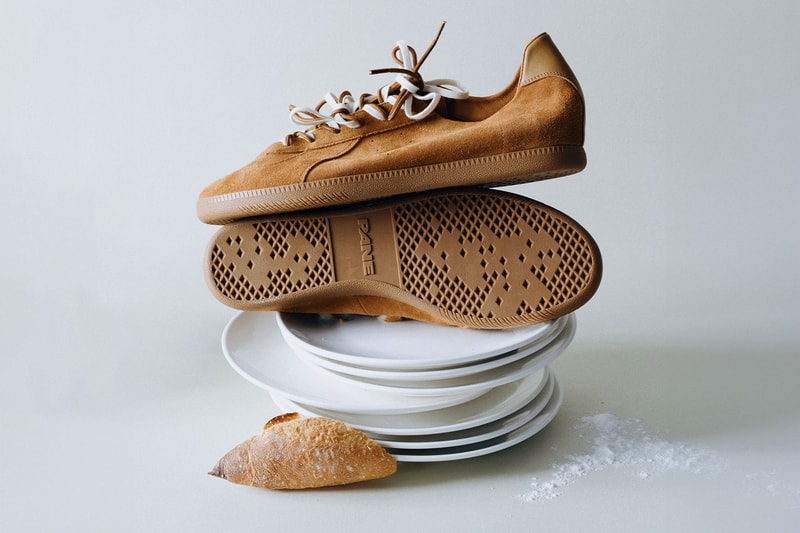
Nearly a century later, the German Army Trainer is more relevant than ever. From luxury fashion houses to sportswear brands, its low-profile design has been embraced by the masses. While countless iterations of GAT-inspired shoes exist, Pane broke through with the introduction of its Light Training NO-GI sneaker. The Chinese brand, established in 2022, skyrocketed in popularity as people were drawn to the NO-GI’s deconstructed aesthetic. For founder Chen Ning and the rest of the team, this was just the beginning.
Rooted in three key design principles: timelessness, motion, and authenticity, Pane utilizes Ning’s decade-long experience in bespoke menswear to deliver footwear meant to be worn habitually. By elevating each touchpoint associated with the brand, from distinct regional storefronts to intentional design choices, Pane seeks to seamlessly integrate itself into your rotation.
We’re only months removed from the launch of its global website, and Pane is on pace to expand its global presence throughout 2026. We caught up with the team to discuss independence, restraint, and what it means to design shoes that simply feel right.


Simply put, what is Pane?
On the surface, Pane makes shoes and apparel. Backing each design is a mission to ensure that people can navigate their everyday lives feeling comfortable, elegant, and true to themselves. However, it’s not simply transactional; it’s a long-term social experience. The entire interaction is considered, from the distinct offline storefronts to the complementary nature of Pane objects with a good book or coffee.
Are there any specific points of inspiration that inform this overarching vision?
A recognizable divide in women’s footwear choices in cities. On one end of the spectrum, traditional formal options such as high heels, and on the other, lifestyle shoes rooted in the DNA of performance brands. Pane is meant to bridge this gap, offering a “quiet confidence” via a combination of technical detailing and elegant style.
What is Pane’s target market?
Since Pane’s inception, we’ve emphasized consumers aged 25 to 45, mostly women-oriented. However, we were surprised to find that our work resonated greatly with men, too. At first, 70-80% of our Instagram following was male, something we did not expect. As a result, we’ve had many requests for expanded sizing options on models like the Zephyr Training, which is inspired by ballet shoes.
“Backing each design is a mission to ensure that people can navigate their everyday lives feeling comfortable, elegant, and true to themselves.”
The brand has already started carving out its own position on a global scale. How does Pane seek to address its various growing regional audiences?
We speak with many different accents, but we have one core language. A shoe like the Light Training NO-GI is built one way, what changes is the way we enter people’s lives in different regions.
For China, we intentionally place ourselves in high-energy, premium retail hubs where performance and style can coexist. Each of our offline shops carries a different theme centered around a vacation state of mind. For example, the Guangzhou store is located in a resort area, and we channel this by including a beverage bar on site, as well as a tennis court under construction.
Internationally, we’ve established strong audiences based in Japan, Bangkok, and the United States. We’re seeking to open our first overseas shops in Thailand this year, with a slow expansion from there, including showrooms in both Europe and America.


What’s the toughest part of operating independently, and how do you navigate it without compromising the product?
The toughest part of staying independent lies in navigating the inherent pressures of scaling and market presence while maintaining a commitment to meticulous craftsmanship and our long-term vision. However, we approach these not as limitations, but design constraints that enforce discipline and purity in our process.
Your remake of the German Army Trainer, the Light Training NO-GI, introduced Pane to a massive audience. How did that sudden momentum shape the way you approached design, pace, and storytelling afterward?
It was less a moment of redirection and more a powerful validation of our founding philosophy. The moment confirmed that modern consumers prioritize authenticity and enduring design over ephemeral trends. Building on this, we were able to strategically expand through new official stores and wholesale partnerships.
“We speak with many different accents, but we have one core language.”
What has been Pane’s approach to curating its offering of silhouettes?
At first, it was important for us to find our signature models, ones that people could immediately recognize as being from Pane. Unlike larger shoe brands that develop these over several years, we aim to introduce new designs annually, if not biannually.
On the apparel side, we started simple: graphic tees, hoodies, and so on. As we look to host our showrooms abroad, it’s important to us to have a complete complement to our footwear selection. So looking ahead, establishing a well-organized apparel line is a priority.
If we fast-forward to the end of 2026, what would a successful year look like for Pane?
There are two specific scenarios that come to mind as anchor points resembling success. The first is a regular Tuesday night in Shanghai. A person comes home from work to pick up a pair of Pane sneakers at the door without giving it any thought, because it’s become a natural choice in their everyday life for feeling relaxed and presentable. The other moment is a morning in Paris. Someone walks by a storefront and sees Pane shoes alongside a local brand that they’ve grown up with, and the new presence is noted, but feels fitting.
Click here to view full gallery at Hypebeast

